Säntis 2026Give the mountain back.
Soldiers went back onto the Säntis to clear ammunition remains and army material left there over the years. I was on the mountain with a camera. Afterwards I asked myself how I would tell this story if it were mine to launch.The photographs are real and mine; the campaign is my answer.
- Role
- Photography on site, concept, copywriting, layout and retouching
- Format
- Poster series · 2:3 portrait, made for print and Instagram
- Subject
- A real clean-up on the Säntis by the Swiss Armed Forces
- Status
- Self-initiated concept, not a commissioned campaign
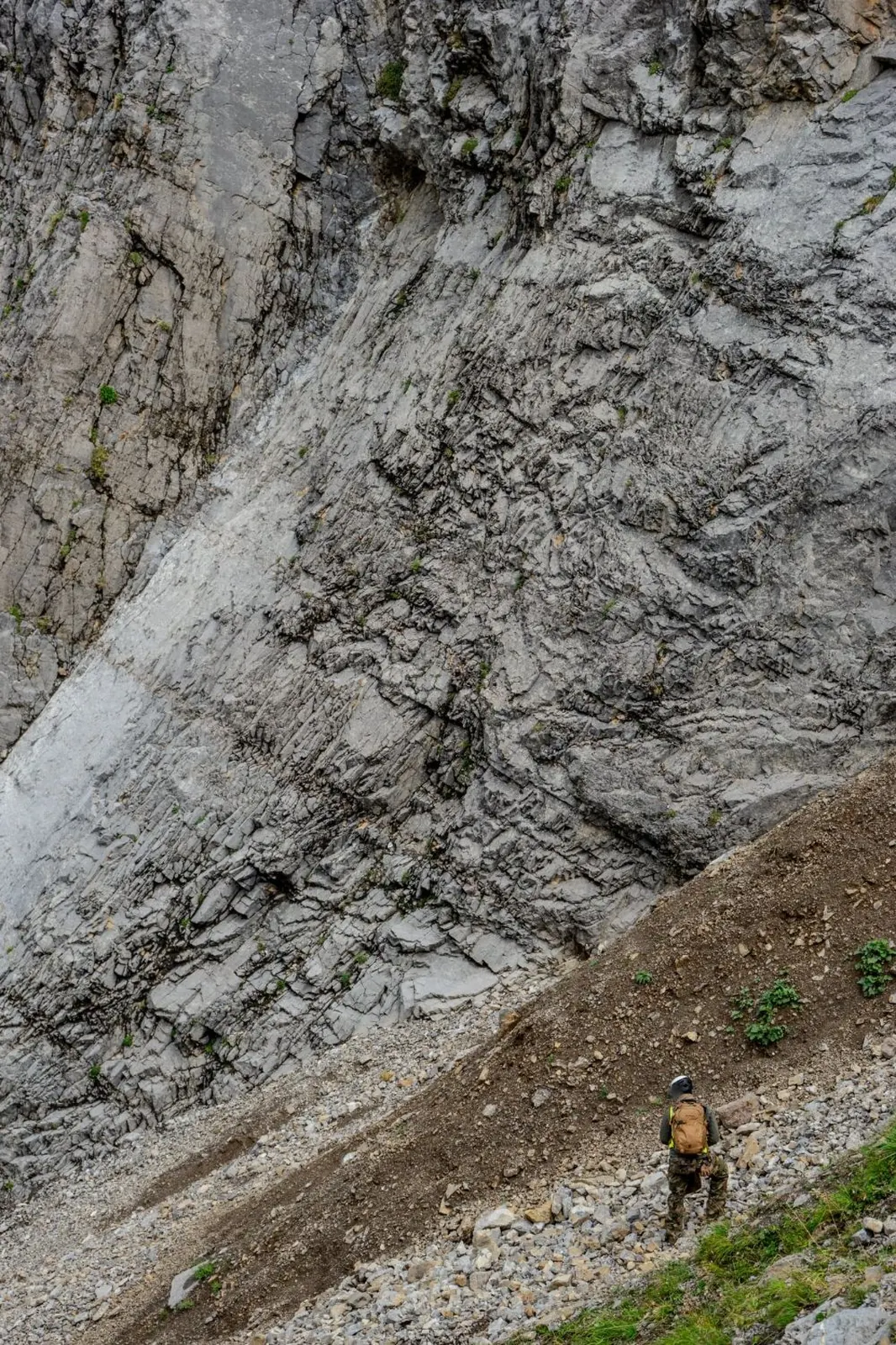
- 01 · ProblemEasy to report, hard to feel.A press release says what was removed and by whom. It rarely says why it matters.
- 02 · AudiencePeople who love the mountains.Hikers, locals and a younger public that judges institutions by what they do.
- 03 · InsightResponsibility has to be seen.It is only believable when you can watch someone carrying it.
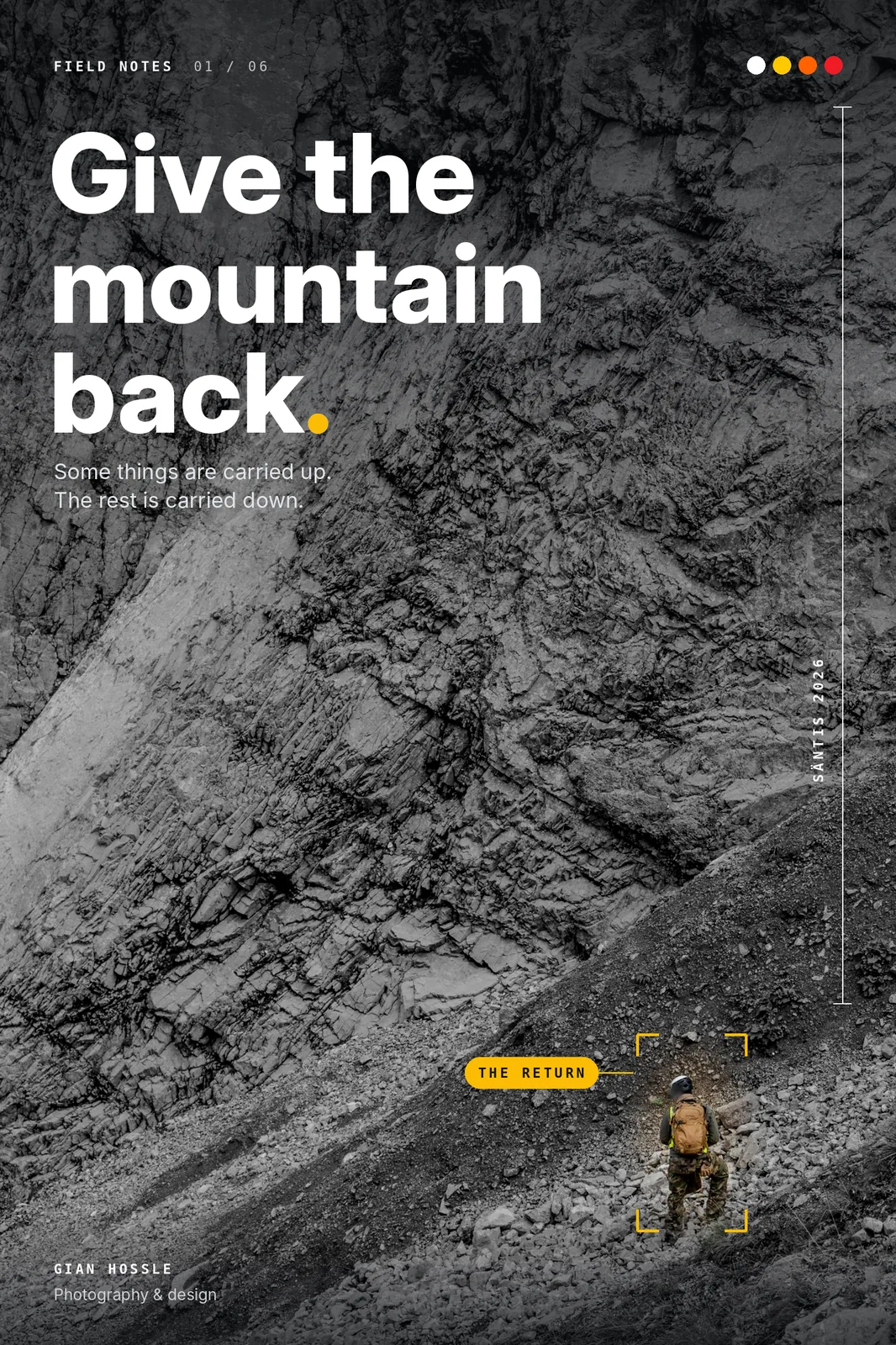
- 04 · IdeaGive the mountain back.A place, a year and one person against the wall. The viewer does the rest.
A press release reports it. Nobody feels it.
Work like this almost never reaches people who don't already follow the army. So the poster drops everything a press release would lead with, and keeps only what you can see.
- What was removed
- By whom, and when
- Read by people who already follow the army
- A place and a year
- One person against a wall of rock
- Seen by anyone who loves the mountains
The restraint is the point
Responsibility is only believable when you can see someone carrying it.
the insight · poster 01
A mountain makes that visible: one person, a whole wall of rock, and the decision to go back up anyway.
The headline never mentions ammunition, clearing or the army. Taking responsibility quietly reads as more honest than announcing it loudly.
- ammunition
- clearing
- army
Searching is the work
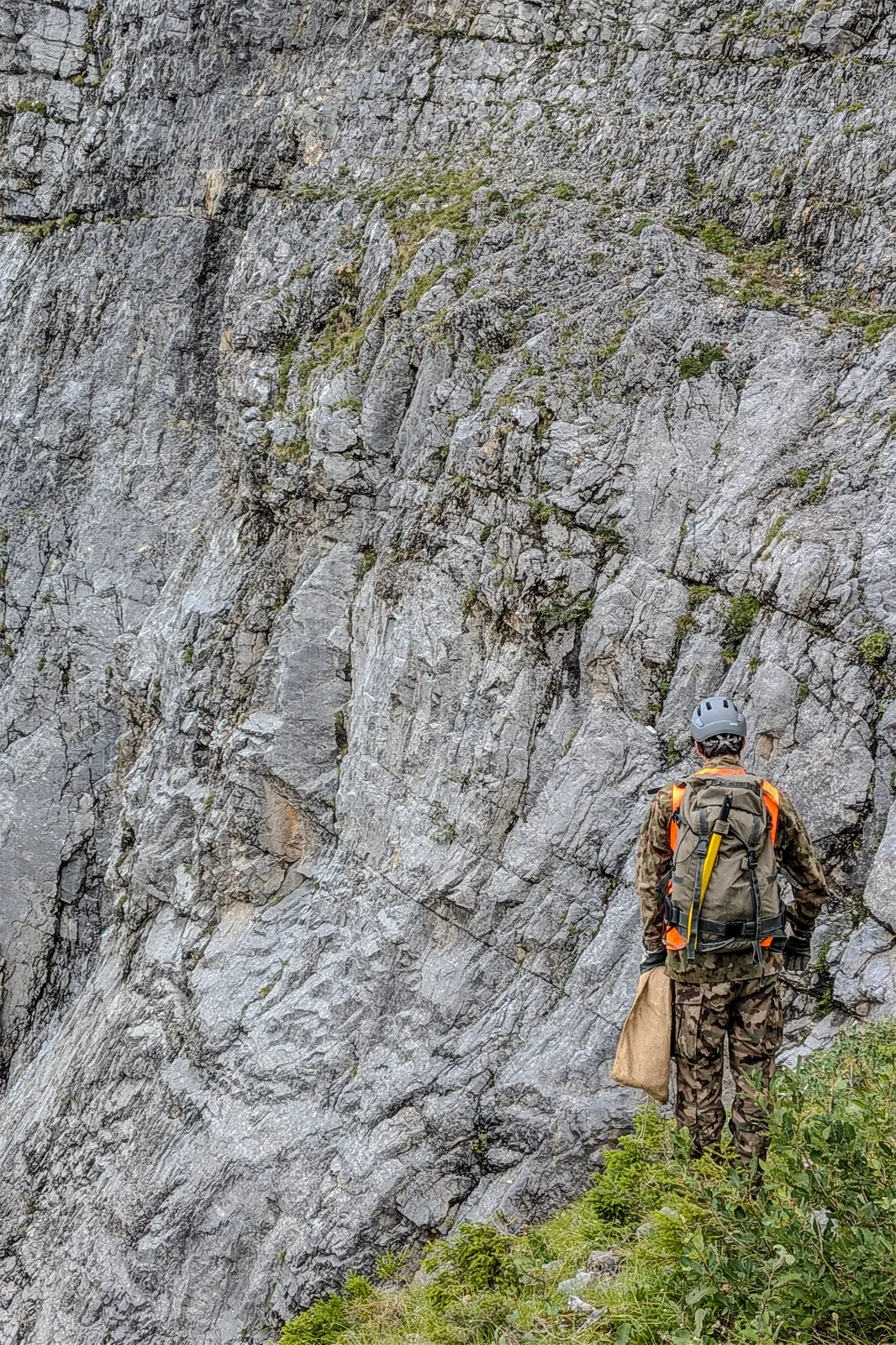
Most of a clean-up is looking: you can only carry down what you have found.
the insight · poster 02
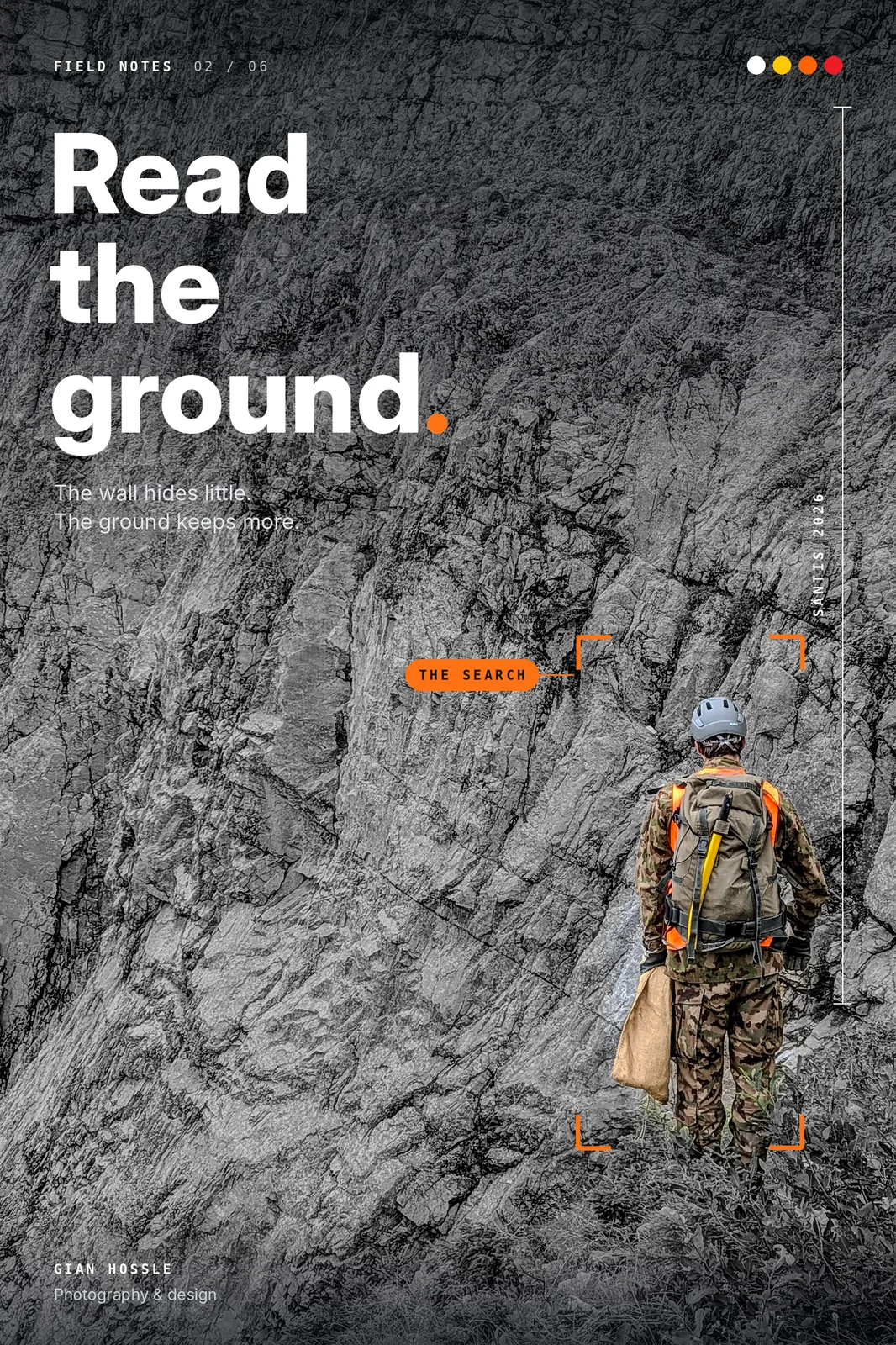
The second poster moves closer. One soldier stands at the wall with a pick and a sandbag, eyes on the ground, in the moment before anything is found.
The line asks the viewer to do the same. It never says what they are looking for; the tools say it quietly.
- ammunition
- search team
- danger
The best trace is none
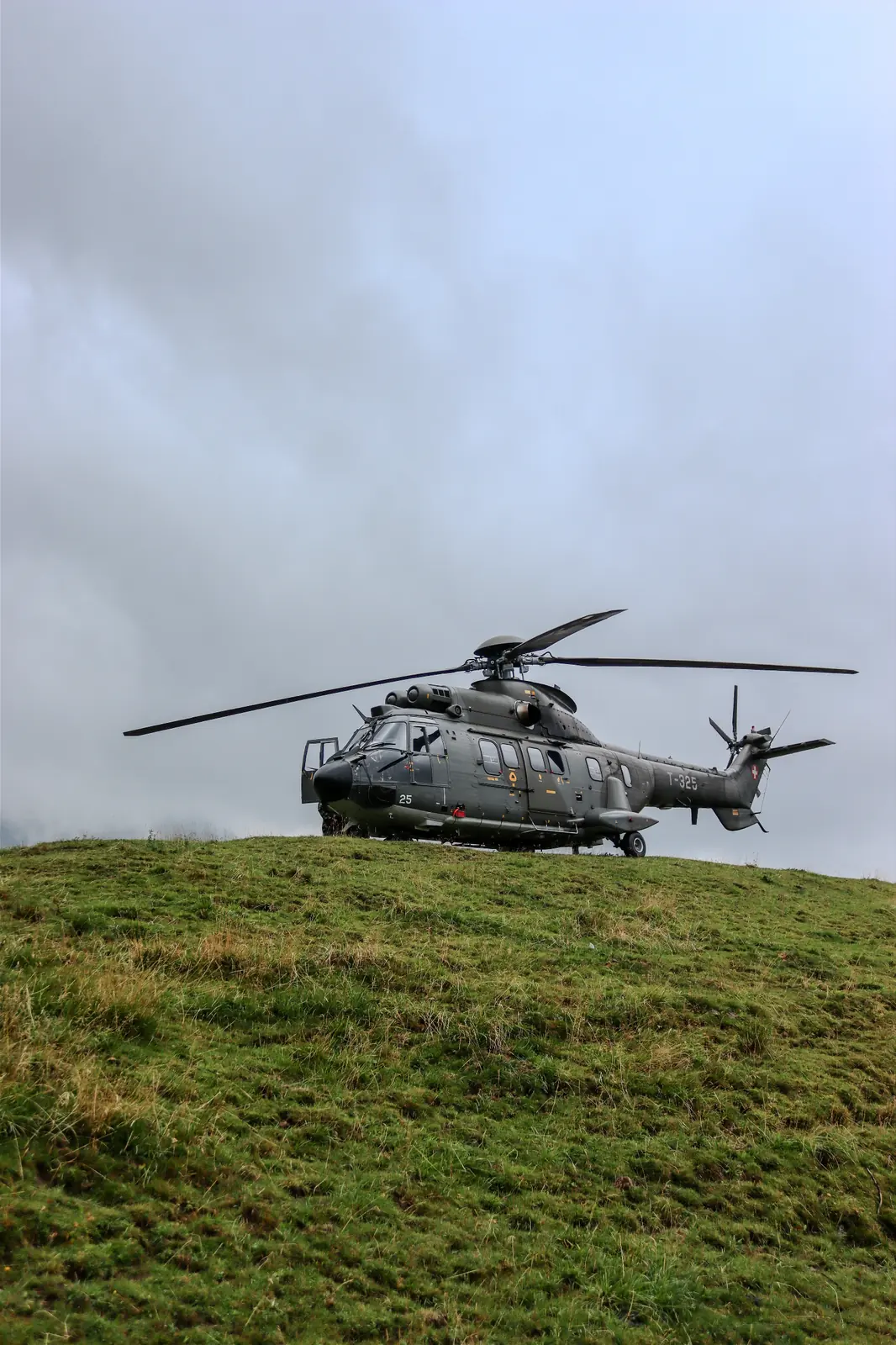
Doing it right means leaving nothing behind, not even yourself.
the insight · poster 03
The third poster has no person in it. A transport helicopter waits on a grassy ridge in flat grey weather: the moment the team and the material leave.
“The last thing to go is us” turns an army exit into a rule every hiker already knows: leave only footprints, or here, only grass.
- helicopter
- army
- transport
Show the weight leaving
What is taken away should be as visible as what was once brought in.
the insight · poster 04
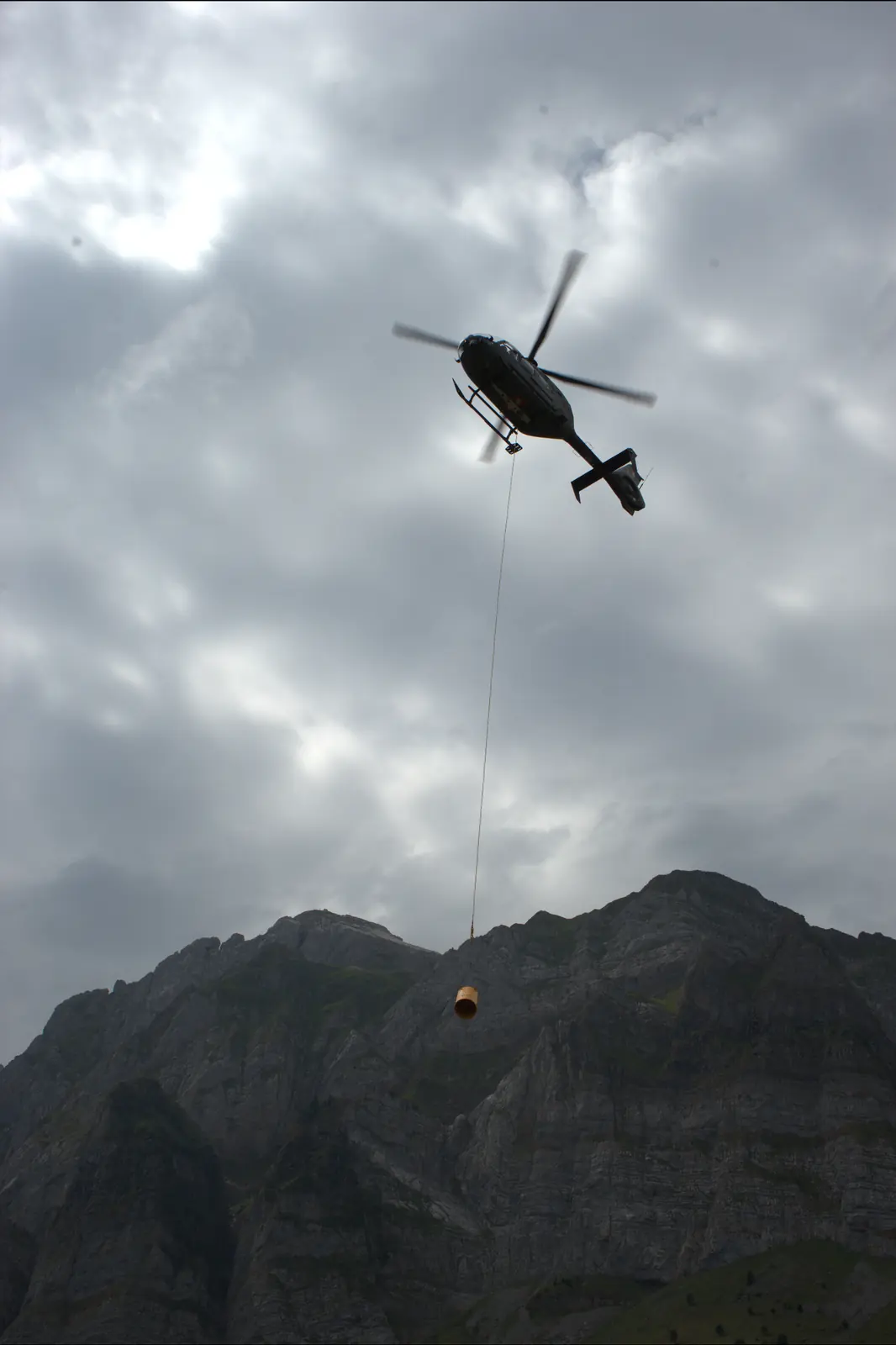
A helicopter lifts a load off the ridge on a long line. Everything goes black and grey except the line and the load: the weight leaving the mountain.
The subline closes the circle, what went up through the air leaves by air. No numbers, no tonnes, just the direction of travel.
- tonnes
- ammunition
- removal
Responsibility is a team
Nobody carries a mountain alone; the line holds because everyone is in it.
the insight · poster 05
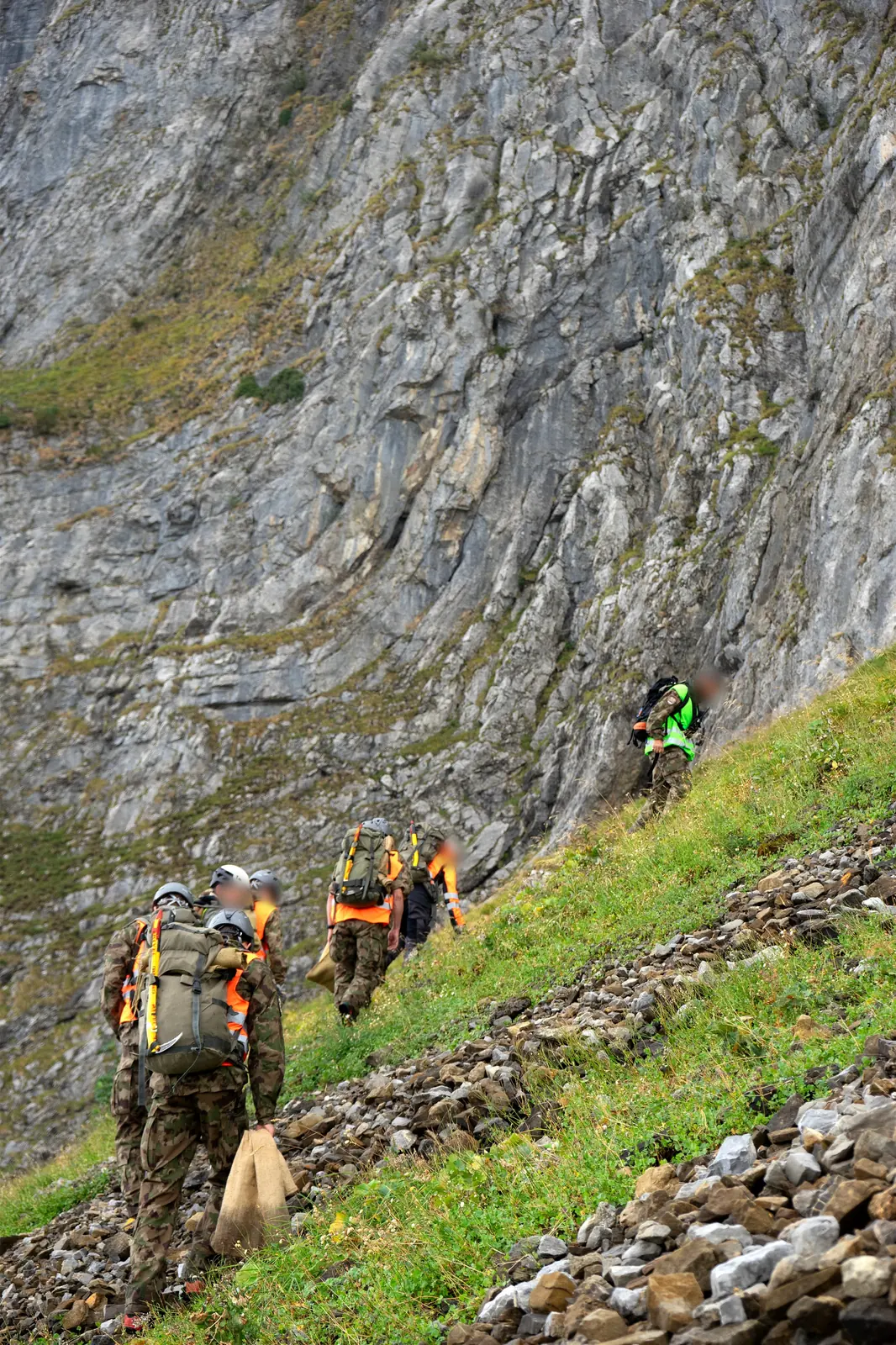
The fifth poster widens out to the whole group climbing in single file under the wall, every person in colour, the one ahead in the brackets.
The headline moves from one person to many. The clean-up is a shared job, and the slope is steep enough to need it.
- unit
- mission
- soldiers
Quiet work, then the record
Doing it quietly is half of it; the other half is being willing to answer for it.
the insight · poster 06
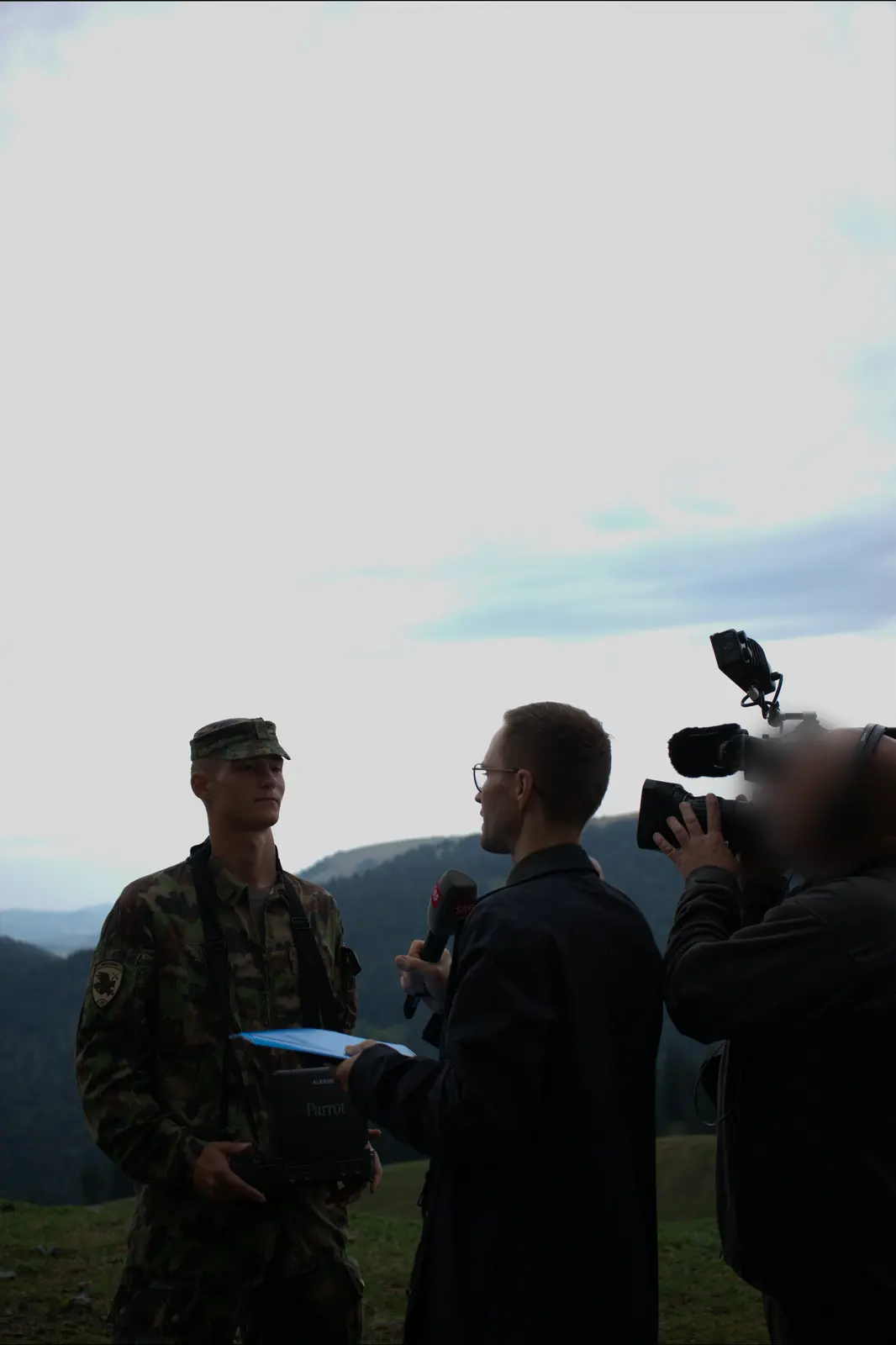
The last poster turns to the telling: a soldier answers a TV crew on the ridge. Only he is framed; the cameraman's face is blurred because he isn't the story.
It closes the series and squares the restraint of the first five posters: the work is shown quietly, and then it is said openly.
- press release
- campaign
- statement
Five choices, poster 01
Pick a swatch to see where each decision lives on “Give the mountain back.”
- poster 01 · decision 01
Black and white, except the person
The mountain is the context, the human is the story. Colour appears only where someone is doing the work.
- poster 01 · decision 02
One yellow accent
Brackets, tag and full stop lead the eye from the headline down to the figure, and nothing else competes for it.
- poster 01 · decision 03
Short lines, lots of rock
Three words per line, and the wall left empty so the scale does the talking.
- poster 01 · decision 04
“Säntis 2026” as the only fact
It sits small beside the wall, like a note in the margin. Anyone curious can look it up.
- poster 01 · decision 05
Faces blurred
The people shown are soldiers on duty, not models. The campaign is about the act, not the individual.
Four choices, poster 02
Pick a swatch to see where each decision lives on “Read the ground.”
- poster 02 · decision 01
Close, and at eye level
The person fills a third of the frame and we stand right behind them, so we look at the wall the way they do.
- poster 02 · decision 02
Orange for the search
The accent moves from yellow to the orange of the high-vis vest. Each stage of the work gets its own colour.
- poster 02 · decision 03
The tools stay in colour
The yellow pick and the sandbag say what the search is without a word of copy.
- poster 02 · decision 04
A wall to be read
The rock fills the poster like a page of text, and the headline asks the viewer to read it as closely as the soldier does.
Four choices, poster 03
Pick a swatch to see where each decision lives on “Leave only grass.”
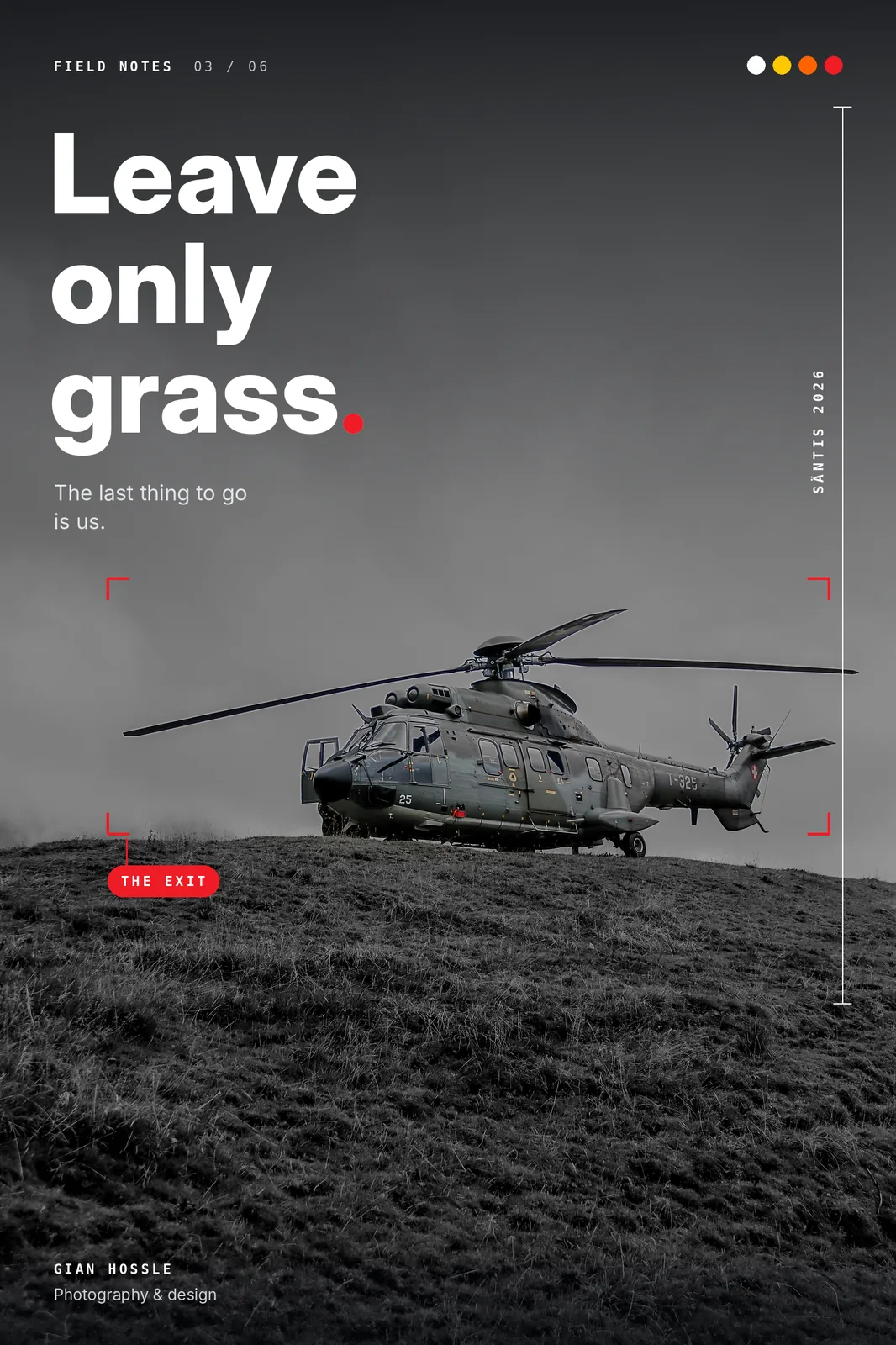
- poster 03 · decision 01
The machine, not the people
For once nobody is in the frame. The helicopter is the exit: the last trace of the work, about to leave.
- poster 03 · decision 02
Red for the exit
The last step gets the strongest colour. Red here means done, and gone.
- poster 03 · decision 03
Half the poster is grass
The ground is the message. Untouched grass is exactly what should be left behind.
- poster 03 · decision 04
Grey weather, no drama
The overcast sky stays flat and grey. The moment is quiet, not heroic.
Four choices, poster 04
Pick a swatch to see where each decision lives on “Lighter by the load.”
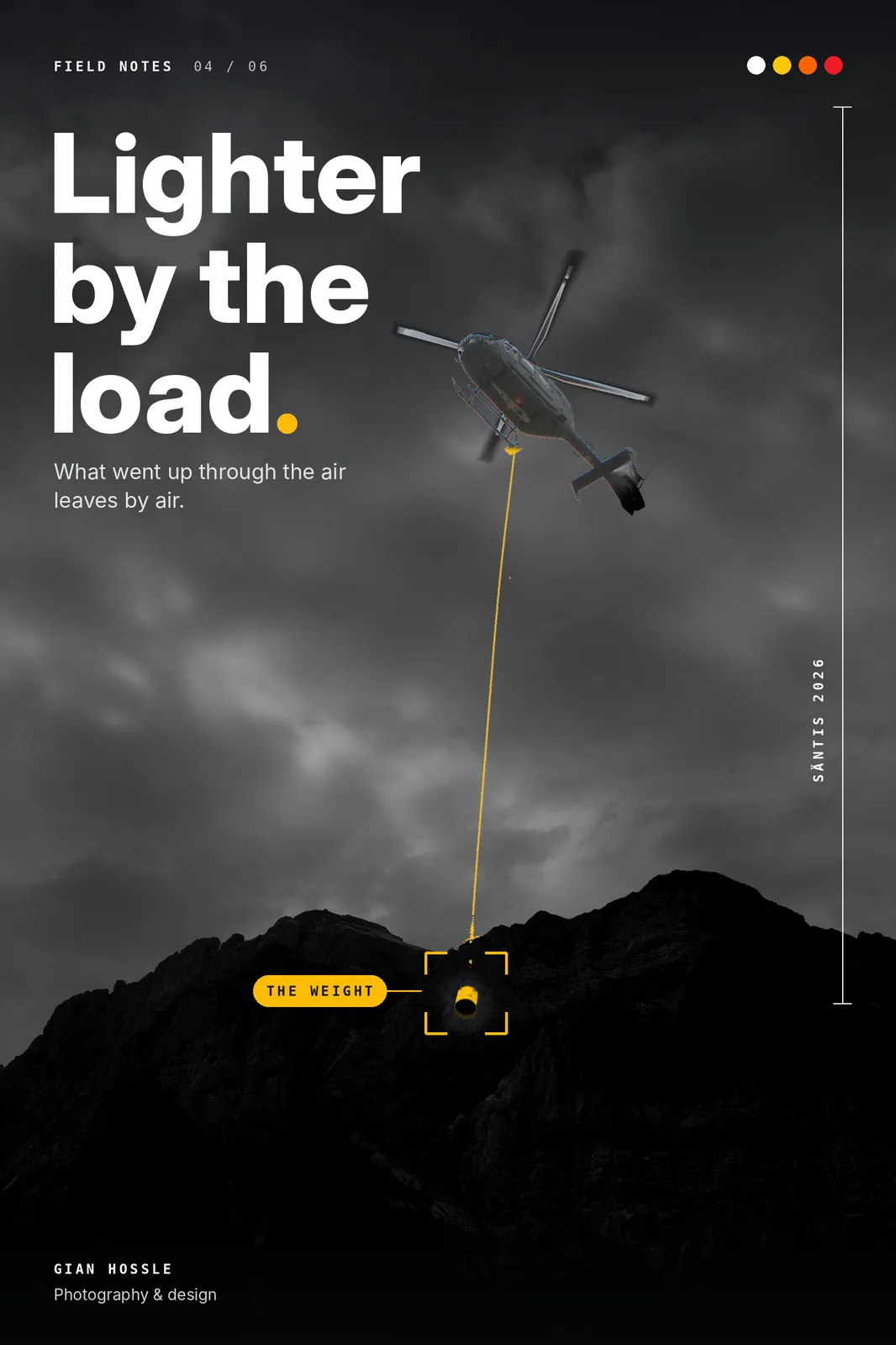
- poster 04 · decision 01
Only the load in colour
The line and the load are the only colour on the poster: the weight being taken away is the story.
- poster 04 · decision 02
Looking up
Shot from below against a darkened sky, so the scale is in the air for once, not on the ground.
- poster 04 · decision 03
Mirrored to fly out
The frame is flipped so the helicopter heads away to the right, out of the poster and away from the mountain.
- poster 04 · decision 04
Dark ridge, light line
The mountain sinks to black so the thin yellow line reads all the way from the top of the poster to the bottom.
Four choices, poster 05
Pick a swatch to see where each decision lives on “Nobody goes up alone.”
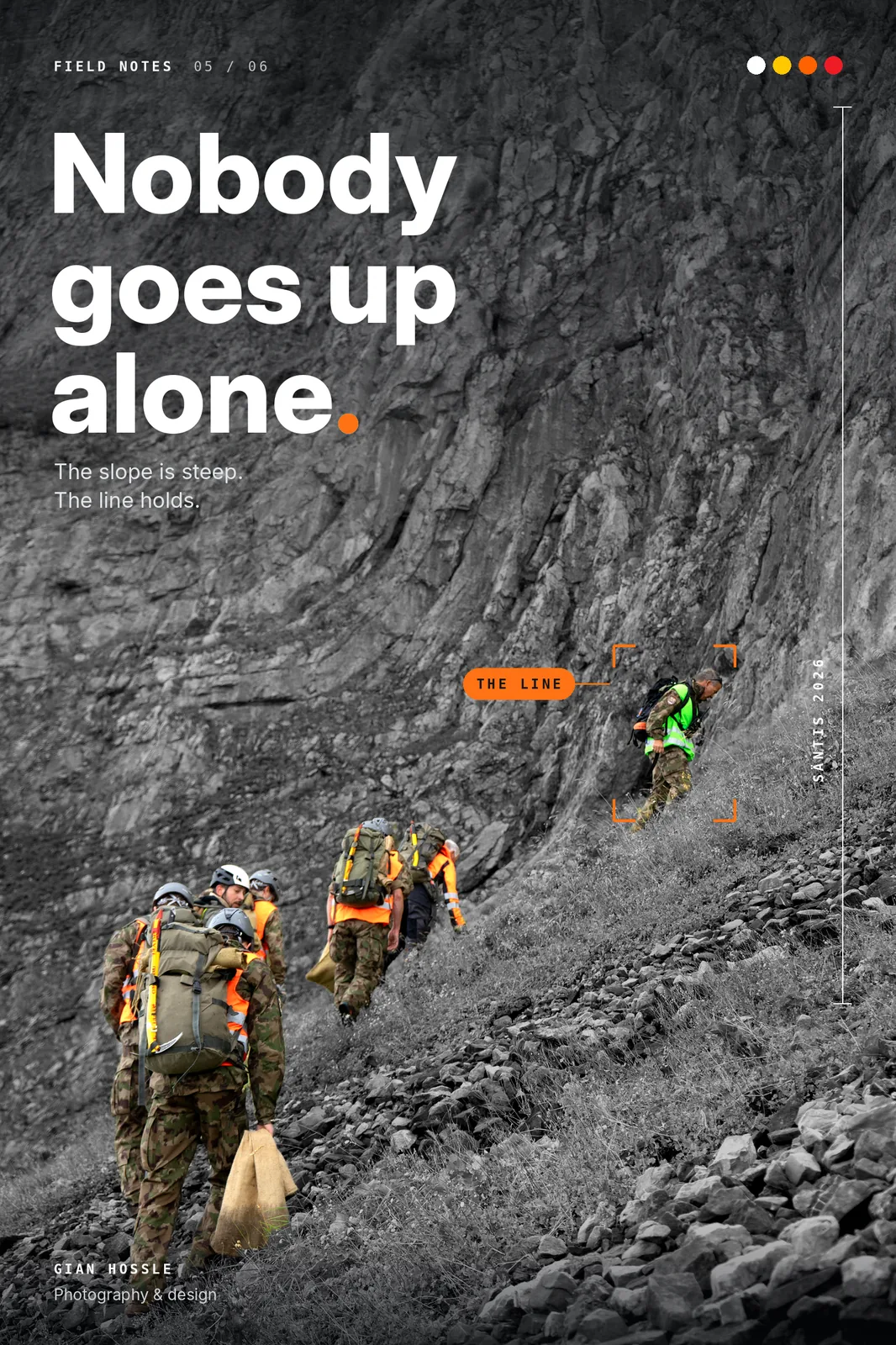
- poster 05 · decision 01
Everyone in colour
This time it's a group. All of them keep their colour, because the line is the subject, not one person.
- poster 05 · decision 02
Orange for the line
Orange again, as on the search: the colour of the vests and of the work in progress.
- poster 05 · decision 03
The bracket on the one ahead
The brackets sit on the person leading: the line holds because someone goes first.
- poster 05 · decision 04
A wall that leans in
The rock fills two thirds of the frame and leans over the climbers, so the steepness needs no explaining.
Four choices, poster 06
Pick a swatch to see where each decision lives on “Then say it aloud.”
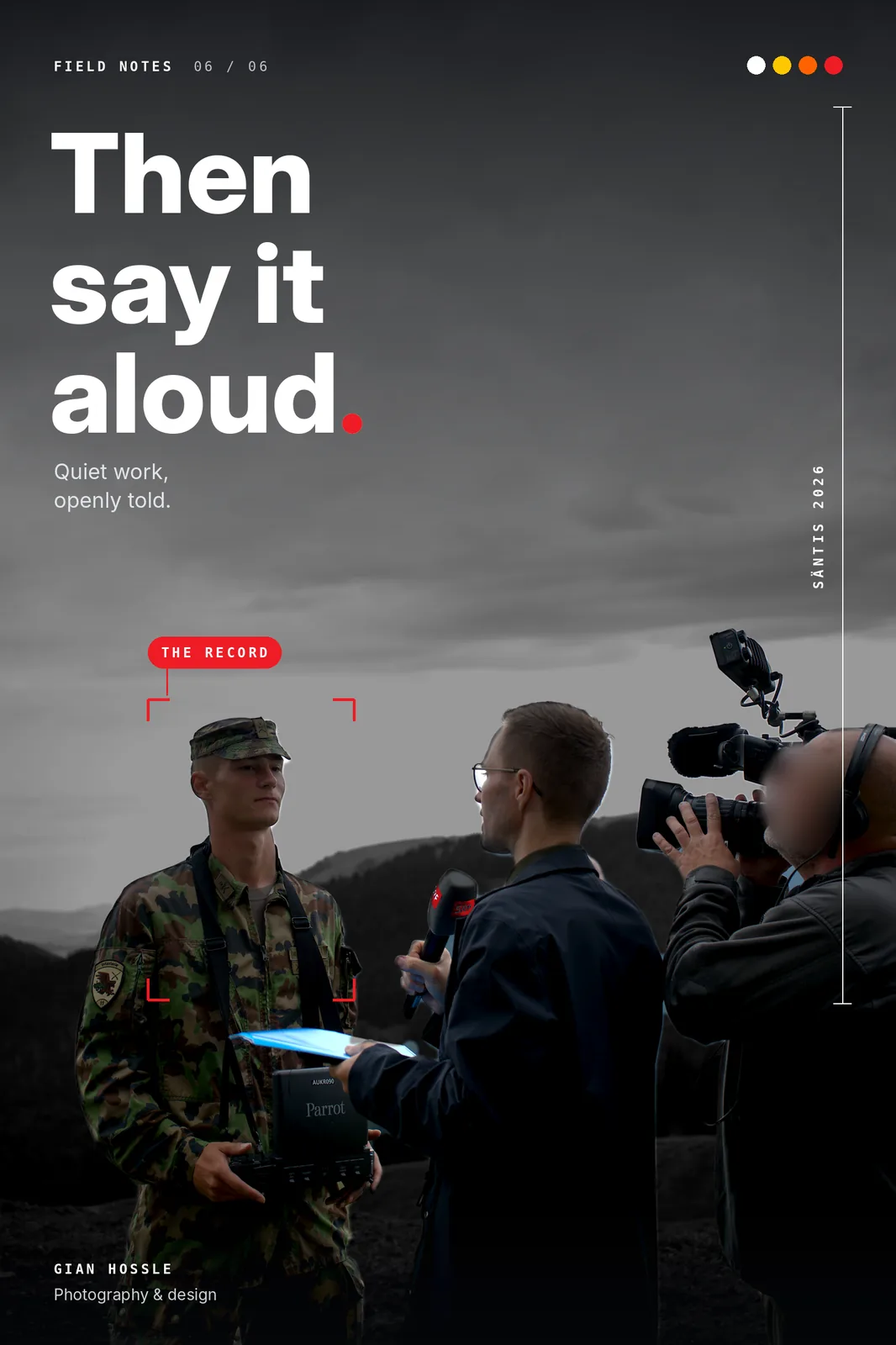
- poster 06 · decision 01
The press is in the picture
The last poster shows the telling itself: a reporter and a camera on the ridge. Owning the work includes answering for it.
- poster 06 · decision 02
One face, on purpose
The soldier speaking for the team is the only clear face in the series. The cameraman's face is blurred: he isn't the story.
- poster 06 · decision 03
Red for the record
The series closes in red, like the exit: the work is done, and now it is on the record.
- poster 06 · decision 04
Dusk and an empty sky
Half the poster is a quiet grey sky. The headline gets room to speak, the way the soldier does.
Not reach alone
If this ran for real, success would mean people outside the usual audience stopped, understood it without help, and came away thinking better of the institution.
- StopDo people outside the army's usual audience stop?Reach and thumb-stop rate in non-army audiences
- UnderstandDo they get it without an explanation?Unaided recall of “Give the mountain back”
- FeelDo they think better of the institution?Sentiment in comments and local press
- ActDo they want to know more?Read-through to the project itself
Do people look closer?
This poster asks for attention to detail, so it works if people look longer and notice more than a headline would tell them.
- StopDo people pause on a poster that is mostly rock?Dwell time against the series average
- UnderstandDo they spot the tools without help?Unaided description of what the soldier is doing
- FeelDoes it read as care, not danger?Care versus fear words in comments
- ActDo they want to know what was found?Clicks to what was found on the project page
Does the rule stick?
This poster borrows a rule hikers already live by, so it works if people repeat it in their own words.
- StopDo hikers stop on a helicopter they'd usually scroll past?Thumb-stop rate among outdoor audiences
- UnderstandDo they connect it to leave no trace?Unprompted leave-no-trace mentions in comments
- FeelDoes the exit read as respect?Positive comments versus noise complaints
- ActDo they pass the line on?Shares and saves against the series average
Is the direction clear?
The poster carries one idea, material leaving. It works if people read that movement without a caption.
- StopDoes the yellow line pull the eye down the poster?Attention heat map on the full poster
- UnderstandDo they read it as taking away, not delivering?Unaided description: removal or supply
- FeelDoes it feel like relief?Words like lighter, clean, relief in comments
- ActDo they ask what was in the load?Questions in comments and clicks to the project
Does the team come across?
This one is about the group, so it works if people talk about them, not about a single soldier.
- StopDoes a group stop people as well as one figure?Thumb-stop rate against posters 01 and 02
- UnderstandDo they see a team, not a queue?Unaided recall of team, together, line
- FeelDoes it build trust in the people shown?Sentiment towards the people in comments
- ActDo they tag someone they climb with?Tags and shares in comments
Does openness build trust?
The last poster links the series to real coverage, so it is measured against the press it points to.
- StopDo people who saw the series stop on the close?Completion rate across all six posters
- UnderstandDo they link the posters to the real project?Searches and clicks for Säntis 2026
- FeelDo they trust the institution more?Trust question in a short pre and post survey
- ActDo they read or watch the coverage?Read-through to the press coverage and project page
measurement plan · the campaign has not run, so there are no results to show
From six frames on the mountain to six finished posters: one series, 25 design decisions and six lines that don't need the army to explain them.
Disclaimer. Säntis 2026 is a real project of the Swiss Armed Forces. This campaign is a speculative concept made for portfolio purposes. It is not an official communication and is not affiliated with or endorsed by the Swiss Armed Forces.
← all creative work